Showing some feedback during CMC collaborative problem solving

In these days I am pretty busy preparing a controlled experiment for my thesis. The setting will involve two participants jointly solving a task which involves a certain degree of reasoning and coordination. I performed a couple of pre-tests using a low-tech prototype and I found that participants were discouraged after a couple of trials because they could not tell whether their proposed solution was correct.

This made me think that in complex situations we need to offer a feedback over the problem-solving process. This seems to be beneficial both for the meta-cognition process and for the engagement that the participants might have with the task. My colleague Patrick Jermann developed his thesis on the subject of mirroring and guidance systems for computer supported collaborative learning.

Subsequently, I developed my own feedback tool for the participant trying to offer some references for the execution of their task. The figure below shows two instances of the tool. The main concept is to show the history of the scores achieved with each proposed solution. The scores are displayed in a graph which evolves over time. In the task I have been designing, there are four main constraints that needs to be optimized by the participants and which contributes to the final score. Each of the four partial scores associated with each constraint are displayed with a different color to offer an additional information to the participants.

Finally the application has some networking abilities to synchronize the actions of the users across the network. The remaining time is also offered in the bottom-lower corner.
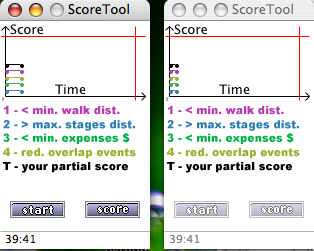
Scoretool

Some links:

[1] Tutorial on Threads Programming with Python

[2] Threading with Python

[3] Basic Threading with Python

Tags: , , ,

How to make photos look like a cartoon/comic book character

The easiest program I was told about was Comic Life for Macs (http://plasq.com/comiclife), but Apple’s Photobooth was also mentioned (although I didn’t try it).  I also was given a link to a how to for Photoshop (http://www.melissaclifton.com/tutorial-popart.html) which looks like it is much higher quality than Comic Life but also much more work.

Comic Life let’s you use image filters to make the image look comic-y, but it doesn’t work well with all images.  It does let you put in speech bubbles and stuff, though, and it looks pretty good.

Tags: ,

Persistance matters: Making the most of chat in tightly-coupled work

D. Gergle, D. R. Millen, R. E. Kraut, and S. R. Fussell. Persistance matters: Making the most of chat in tightly-coupled work. In Proceeding of CHI2004, pages 431–438, Vienna, Austria, April 24-29 2004. ACM Press. [pdf]

————-

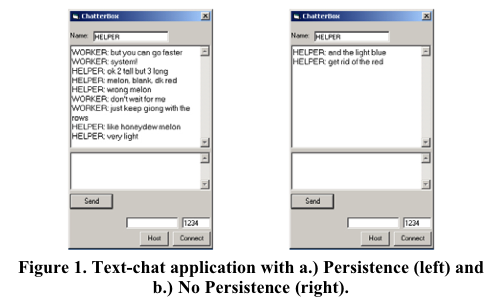
This paper present a controlled experiment to asses the effect of the history of conversation on task performances. The study shows how the history of the conversation has an impact on computer-mediated communication tasks that require semantic coordination to disambiguate utterances.

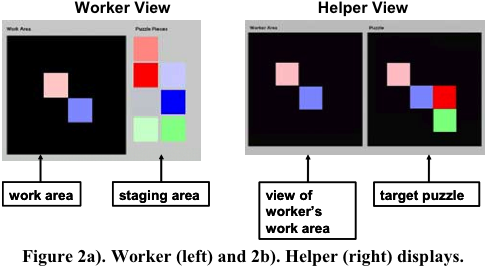
The author used a puzzle task where an “helper” has to guide the “worker” to solve the puzzle. In their experimental setup the author controlled wether the helper could see the space of interaction of the worker and can refer to the objects by the mean of deictic expressions. The shared visual space is a resource for grounding that makes the conversation more efficient.

The results demonstrate the importance of two resources for conversational grounding: a persistent dialogue history and a shared visual space.

How much history of the dialogue should a chat client include? Some chat clients have minimized the dialogue history to deploy the space for other purposes. A theory of conversational coordination suggests that stripping away history raises the cost of conversational grounding, creating problems for both writers and readers. To test this proposition and inform design, we conducted an experiment in which one person instructed another on how to solve a simple puzzle. Participants had chat clients that showed either a single conversational turn or six of them. Having the dialogue history helped collaborators communicate efficiently and led to faster and better task performance. The dialogue history was most useful when the puzzles were more linguistically complex and when instructors could not see the work area. We present evidence of participants adapting their discourse to partially compensate for deficits in the communication media.

Fussell History-Chat  Fussell Puzzle-Task

Tags: , , , ,

Attrape-Moi si tu peux

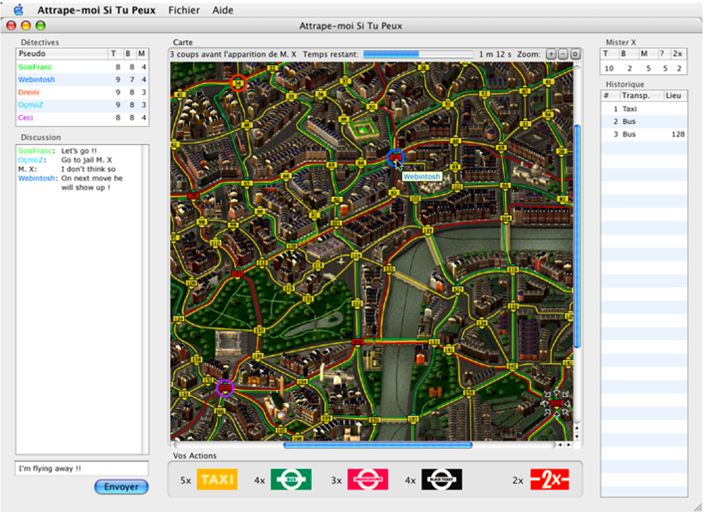
Attrape-moi si tu peux (catch me if you can) is a network game where the goal is to catch a murderer, Mister X, who is hiding in the center of London. The Scotland-Yard inspectors, the players, have to follow some hints to find him but dealing with “the city” transport system. They have a limited number of tickets to move around and they have to spend them consciously to find the murder. The game has been developed at Software Engineering Laboratory, at EPFL.

AT T R AP E – MOI SI TU PE UX est un jeu de stratégie en réseau où une équipe de détectives tente d’arrêter Mister X dans sa fuite. Une bonne communication et un sens aigu de la déduction sont nécessaires pour réussir à AT T R AP E – MOI SI TU PE UX, que l’on soit détective ou Mister X.

Catchmeifyoucan Epfl-1

Tags: , ,

3D Time Lapse video of plants

The Carnivorous Syndrome in 3D explores the astounding lives of the carnivorous plants, in mind-bending 3D. Travel to the Venezuelan tepuis, African Savannahs, and the rainforests of Borneo, while learning about the mysterious plants which live there. Discover the beauty and complexity of these fascinating creatures.

Featuring unprecedented close up 3D time lapse video shot by jasper, a robot made of Lego (R) bricks. Additional habitat photography by Chiaki Shibata and Romuald Anifraix. Also featuring stunning 3D animation, and an incredible electronic soundtrack composed by John Teagle. Narrated by Marguerite C. Wilson. Written and directed by Mike Wilder.

3Dsyndrome

Tags: , , , , ,

How to make visual timelines

Here are some of the resources that people pointed me towards:

– http://ganttproject.sourceforge.net (project management tool with timeline feature)

– other gantt chart tools, like http://echo2gantt.sourceforge.net

– MS Project

– Other, more free-form project organization tools, such as “Basecamp” at: http://www.37signals.com

– http://simile.mit.edu/timeline/ (simile timeline – this is what I think I’ll end up using)

The effects of technical illustrations on cognitive load

K. N. Purnell, R. T. Solman, and J. Sweller. The effects of technical illustrations on cognitive load. Instructional Science, (20):443–462, 1991. [pdf]

————-

The effects on cognitive resources of splitting attention between technical illustrations and their descriptors were examined in four experiments with high school students of good to very good reading ability. Experiment 1 looked at the effect of having descriptors incorporated within technical illustrations and found that there was an observable advantage for combined formats over split formats. In Experiments 2,3 and 4 the combined form of presenting a technical illustration was superior to having the descriptors for the technical illustration in an adjacent key. Attempts to obtain increases in the advantage for the combined format with reinforcement failed to demonstrate any reliable result. These data suggested that the format of technical illustrations which required students to integrate mentally disparate sources of information imposes a heavy cognitiveload. It was concluded that the format of technical illustrations was superior when descriptors were contained within the diagram as cognitive resources were not required to integrate the descriptors and the diagram.

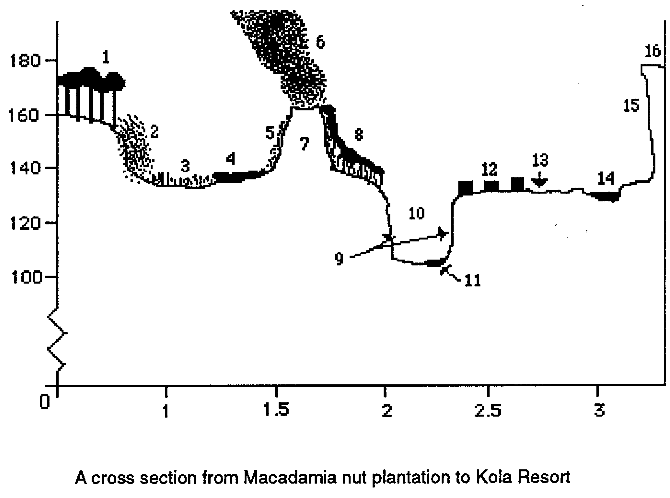
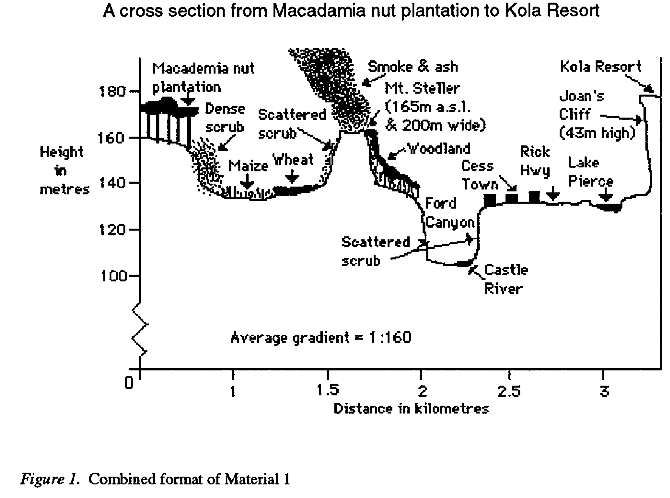
The results of this work show that technical material consisting of mutually referring, disparate sources of information that cannot be understood in isolation should be integrated into a unitary entity. Using this solution, the authors found both memory of those elements and the ability to make inferences beyond those elements to be facilitated compared to the frequently used structures that incorporate distinct sources of information. In the picture below, the experimental material used with the split key, on the left, and with the combined key, on the right.

Purnell Technical-Illustration Split  Purnell Technical-Illustration Combined

Tags: , , , ,

How to write an Informed Consent Form for Psychological Experimentation

I have been involved many times in experimentations which required human subjects. That’s recurrent for each HCI researcher. As I have been working both in the States and mainly in Europe I also noticed great differences in the practices around these experiments: while in the States there are lots of protocols in place, in Europe things are a bit more, … hum …, fuzzy!

EPFL, for instance does not have proper guidelines. Probably because our lab pioneered HCI research  into this technical school with no tradition around these themes. I like the American way, in this regard, and I would love to have some more “structure” around these experiments.

To start off the discussion I think is important to have a proper Consent Form whenever we host an experiment involving humans. Each participants should be made aware of the following:

1. The purpose of the experiment;

2. The aim and procedure of the experiment;

3. The risks related to the execution of the task;

4. The time required;

5. The conditions of participation and withdrawal;

6. The benefits obtained in participating;

7. The confidentiality of the results;

8. How and where the results will be published;

9. The person/lab responsible for the experiment.

I tried to google around to find some templates but with no satisfactory results. I found an example from Harvard, one from Grinnell university and one from myself 🙂 Here are some nice guidelines.

Tags: , ,