A comparison of speech versus typed input

A. G. Hauptmann and A. I. Rudnicky. A comparison of speech versus typed input. In Proceedings of the Third DARPA Speech and Natural Language Workshop, pages 219–224, San Matteo, 1990. Morgan Kaufmann. [pdf]

——-

This paper describes a controlled experiment in which the author compared two input modalities: text and speech. The author designed a task where the subjects had to input a number of numeric strings to the computer. They either used their voice, the keyboard or a combination of the two. They used a number of custom made metrics, like the transaction error rate (the number of transactions that were absolutely necessary divided by the total number of transactions); aggregate cycle time (the total time a subject needed to enter a number correctly).

The utterance accuracy results showed that speech requires many more interactions to complete the task than typing. According to the metrics defined typing reported better results in comparison to speech. The author discussed several reasons of why it was the case.

The author showed how speech compares with typing for the entry of digit string tasks. However, the authors cautioned how real world task, requiring more keystroke per syllable, would demonstrate the effectiveness of speech much better.

The authors concluded that depending on the task, speech can have a tremendous advantages for casual users. The more a task requires visual moniotoring of input the more preferable speech will become as an input medium. For skilled typist these relation might be reversed.
PhD thesis presentation: Annotations of Maps in Collaborative Work at a Distance

Yesterday, I presented publicly my thesis to the Faculty of Informatics and Communication at EPFL. I also delivered the final version of the thesis to the registrars office of the university. This final version has an extra page at the end with some minor corrections (thanks to Darren Gergle for the suggestions). The PDF of the thesis can be downloaded here (371 pages, 42.7 Mb), while the slide deck I used for the presentation of this work can be downloaded here (57 slides with notes, 5 Mb).

As a part of the presentation of the work, I prepared a little animation which shows a typical interaction an user might have with STAMPS. Here you can download this movie (divx, 700 Kb).

Title: “Annotations of Maps in Collaborative Work at a Distance”

(thesis director: Pierre Dillenbourg)

Abstract:

This thesis inquires how map annotations can be used to sustain remote collaboration. When we are face-to-face, we can point to things around us. However, at a distance, we need to recreate a context that can help disambiguate what we mean. A map can help recreate this context. However other technological solutions are required to allow deictic gestures over a shared map when collaborators are not co-located. This mechanism is here termed Explicit Referencing.

Two filed experiments were conducted to investigate the production of collaborative annotations of maps with mobile devices. Both studies led to very disappointing results. The reasons for this failure are attributed to the lack of a critical mass of users (social network), the lack of useful content, and limited social awareness. More importantly, the study identified a compelling effect of the way messages were organized in the tested application, which caused participants to refrain from engaging in content-driven explorations and synchronous discussions.

This last qualitative observation was refined in a controlled experiment where remote participants had to solve a problem collaboratively, using chat tools that differed in the way a user could relate an utterance to a shared map.

Results indicated that team performance is improved by the Explicit Referencing mechanisms. However, when this is implemented in a way that is detrimental to the linearity of the conversation, resulting in the visual dispersion or scattering of messages, its use has negative consequences for collaborative work at a distance. Additionally, a primary relation was found between the pair’s recurrence of eye movements and their task performance.

Finally, this thesis presents an algorithm that detects misunderstandings in collaborative work at a distance. It analyses the movements of collaborators’ eyes over the shared map, their utterances containing references to this workspace, and the availability of ‘remote’ deictic gestures. The algorithm associates the distance between the gazes of the emitter and gazes of the receiver of a message with the probability that the recipient did not understand the message.

Social functions of location in mobile telephony

I. Arminen. Social functions of location in mobile telephony. Personal Ubiquitous Computing, 10(5):319–323, 2006. [PDF]

——–

This paper describes a conversational analysis of mobile phone conversations. The author tried to understand why and how people communicate their location in phone calls. The study extends the study of Laurier and Weilenmann in that this study elaborate the way in which location features in mobile users’ communicative behavior.

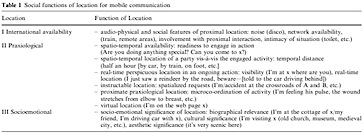
The author finds five situations in which location is used in mobile conversations. The first is the interactional availability (registered in the author’s dataset 15% of the time), or the availability to discussing the content of the phone call; The second is when the communication of location has an importance in the ongoing activity (22% of the cases), like when a car driver has to ask direction to a remote speaker. Seemingly, location might assume importance during the call as part of the activity the parties are involved into (9%) and as a prompt for future activities (48%, the majority of situations registered). Finally, location can be communicated even if it does not have any relevance for the activity at hand. In this case the author say that it has a social relevance (6% of the cases).

One of the author’s main implication of this study lies in the fact that according to him, location is never considered in purely geographical terms. Location is made important by the activities in which the parties are involved. Particularly, joint activities make spatio-temporal patterns.

200806181643.jpg

Formulating availability and location in mobile phone conversations

A. Weilemann. “i can’t talk now, i’m in a fitting room”: formulating availability and location in mobile phone conversations. Environment and Planning A, 35(9):1589–1605, 2003. [pdf]

————-

This paper describes an analysis of recorded phone conversations. The author tried to understand the interrelations of location, activity, and availability. Indeed the author showed how in mobile phone conversations people exchange spatial information to infer the availability of the other to talk. Place can be inferred from the activity and vice-versa as people might have a good understanding of their peers whereabouts.

In this paper I investigate the ways in which participants in mobile-phone conversations orient to each other’s location, activities, and availability. By looking at data from recorded mobile-phone conversations, I use a conversation analytic approach to make initial observations on the character of mobile-phone conversations. I found that the frequent question “what are you doing?” sometimes caused a location to be given as part of the answer which shows how location, activity, and availability are strongly related. The participants thus obtained information about location, when this was considered relevant, through asking about activity. Location seemed especially relevant if it provided information about a future meeting. In some of the conversations where it seemed there was something going on where the ‘called party’ was located, the ‘caller’ reacted by initiating the conversation with a strategy which gave the called party a chance to end the conversation.

Location and activity sharing in everyday mobile communication

F. R. Bentley and C. J. Metcalf. Location and activity sharing in everyday mobile communication. In CHI ’08: CHI ’08 extended abstracts on Human factors in computing systems, pages 2453–2462, New York, NY, USA, 2008. ACM. [PDF]

————-

This paper presents an interesting study of location-disclosure in mobile phone conversations. They were interested in what kind of location and activity information is provided and how context might influence this information disclosure. The authors were particularly interested in the purposed of disclosing location and activity information. The authors felt that there was a need for understanding additional details of location-sharing in mundane situations and detailing the requests-for and responses-to location disclosures.

The authors used a pretty interesting technique, enrolling 7 participants who recorded their phone calls and then analyzed the resulting 176 recordings looking for patterns and similarities. First they parsed each message using annotation techniques refined in the conversation analysis domain (see Hutchby and Wooffitt, 1992, or Psathas, 1995). They also used qualitative techniques to look for affinity diagrams modeled on grounded theory.

They found several significant correlations, like the association of the disclosure of current location at the opening of a conversation. Past location was often disclosed in the middle of a sentence, while future location was more often disclosed at the end of a conversation. The authors distinguished 8 different situations in which location/activity is disclosed: 1) social awareness in order to feel more connected with other people; 2) managing availability; 3) planning to meet and micro-coordination to reach proximity; 4-7) disclosures to help others to check whether a person need anything from a particular location and to show caring; 5-6) disclosure as a mechanism to continue or to end the conversation; finally 8) as a process awareness in work.

An interesting finding is that according to the authors, is that people in the same social network often can infer each others’ whereabouts with a great precision. However they are often unsure of the exact transitioning times between activities or locations. Often these correct inferences are constructed from a small amounts of seemingly ambiguous data given past knowledge about that person’s interactions with the world. The authors call this a ambient noise, which is ofen thought by other researchers as something that needs to be filtered out. However, this study points out the importance of this information for enabling the function of grounding in the group, which serves coordination and therefore communication and collaboration.

Deixis and Gaze in Collaborative Work at a Distance

This is the abstract of the talk I gave yesterday in Nottingham. I was invited by Geoff Underwood and Tom Foulsham to participate in their seminars held in the psychology faculty of the university. The slides of the talk can be downloaded here.

When we are face-to-face, we can point to things around us. However, at a distance, we need to recreate a context that can help disambiguate what we mean. A map can help recreate this context. However other technological solutions are required to allow deictic gestures over a shared map when collaborators are not co-located. This mechanism is here termed Explicit Referencing.

In this talk I will present a controlled experiment where remote participants had to solve a problem collaboratively, using chat tools that differed in the way a user could relate an utterance to a shared map. Results indicated that team performance is improved by the Explicit Referencing mechanisms. However, when this is implemented in a way that is detrimental to the linearity of the conversation, resulting in the visual dispersion or scattering of messages, its use has negative consequences for collaborative work at a distance. Additionally, an analysis of the eye movements of the participants over the map helped to ascertain the interplay of deixis and gaze in collaboration. A primary relation was found between the pairŐs recurrence of eye movements and their task performance.

Finally, I will present an algorithm that detects misunderstandings in collaborative work at a distance. It analyses the movements of collaboratorsŐ eyes over the shared map, their utterances containing references to this workspace, and the availability of ÔremoteŐ deictic gestures. The algorithm associates the distance between the gazes of the emitter and gazes of the receiver of a message with the probability that the recipient did not understand the message.

A location-based reminder app

Lately, I have been thinking about this concept of location-based reminders (LBR). The idea is quite simple. a classical reminder is usually defined for a certain time, while a LBR is defined for a certain place. Setting a LBR opens a whole range of new possibilities as we can combine space and time in different manners to accommodate different behaviors (e.g., being reminded to buy milk while close to the grocery store but only on friday and sunday morning). I remember several projects done in the past that should have achieved exactly this point, like DeDe. However, they all failed because people are uncertain about their spatio-temporal patterns when communicating with other friends.

More specifically, the value of LBR is related to the fact of being reminded while being on the place. However the caveat is that either we are certain about our path in the city, in which case the value of the LBR is reduced, either we are uncertain about the path, the value of the LBR stays high but we can find ourself at home without milk.

Defining a spatio-temporal pattern is not a trivial task. Learning meaningful location is the first step but it is certainly not the added value of the application.

[Geominder, a simple LBR app] 

Alterszorn

Reading one of the comics I like the best, Nathan Never, I learned an interesting German word: “alterszorn”. It means the ‘rage of age’, and refers to the habit of some older people to go over the polemical edge. The word was used by John le Carré, a British spy-novelist. Contrary to those that with older age become conservatives, calm, and in favor of the status quo, John le Carré took the inverse path because book after book he took a critical attitude towards people in charge, e.g., politicians, and their ability to manipulate, and falsify. This becomes more visible in one of his last books: Absolute friends.

I hope I will get alterszorn when I will more mature …

Absolutefriends

penetration of EM waves

The other day, I had a nice chat with Paolo on the science behind these products that shields electro-magnetic (EM) waves. He recalled the formula that is used to calculate the skin depth of a conducting material in order to understand whether a certain EM signal can penetrate it or not.

An electromagnetic wave entering a conducting surface is damped and reduces in amplitude by a factor 1/e in a distance ∂ given by: 

Skindepth002

where ω is the angular frequency of the radiation and σ the electrical conductivity of the metal. This distance is referred to as the skin depth of the conductor. The effect is caused by electromagnetic induction in the metal which opposes the currents set up by the wave E-field, and holds for oscillations below about 1012 Hz.

[more]