Last Saturday we spent some time in Besançon, in France. It is a lovely city. Downtown is a pedestrian area with lots of shops and restaurants. Here are some pictures.
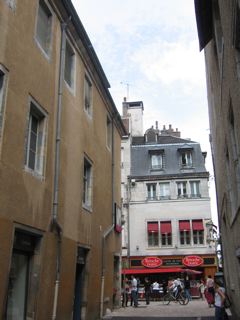
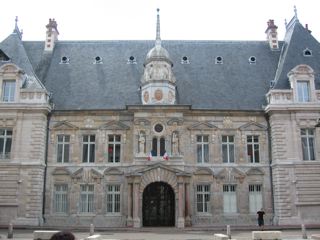
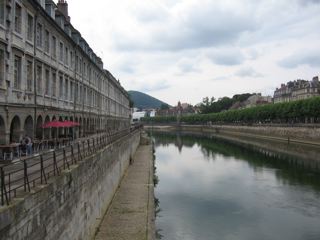

Last Saturday we spent some time in Besançon, in France. It is a lovely city. Downtown is a pedestrian area with lots of shops and restaurants. Here are some pictures.
L’8 settembre sarà il giorno del Vaffanculo day, o V-Day. Una via di mezzo tra il D-Day dello sbarco in Normandia e V come Vendetta. Si terrà sabato otto settembre nelle piazze d’Italia, per ricordare che dal 1943 non è cambiato niente. Ieri il re in fuga e la Nazione allo sbando, oggi politici blindati nei palazzi immersi in problemi “culturali”. Il V-Day sarà un giorno di informazione e di partecipazione popolare.
Beppe Grillo

Clark, H. H. Pointing: Where language, culture, and cognition meet. Lawrence Erlbaum Associates, Mahwah, NJ, USA, 2003, ch. Pointing and placing, pp. 243–268. [pdf]
———
In this chapter Clark explains why pointing is so important to communication. He says that communication is ordinarily achored to the material world and that one way it gets anchored is through pointing. Clark also explains that it exists a counterpart of pointing: placing. Trrough the use of our position and the position of the objects we refer to in the actual worlds, we shape context to reduce misunderstanding and making communication more efficient. He argues that directing-to and placing-for are two communicative acts. Indicative acts, to be precise.
Indicating has fundamentally to do with creating indexes for things. Clark explains how every indication must establish an intrinsic connection between the signal and its object. The more transparent is this connection the more effective is the act.
Indicating an object in space must also lead the participants to focus attention on that object, or in other words, anything which focuses the attention is an index. Finally every indication must establish a particular interpretation of its object. That is why we cannot use an indication that stands on its own. Also this is connected to the fact that we often find pointing-to and placing-for devices combined.
Clark highlights also how gazing is a communication device for directing the addressees’ attention to objects. However eye gaze is special as people use the direction of their gaze to designate the person or things they are attending to. Also, eye gaze is not effective unless it is registered by the person being gazed at. So we talk often of mutual gaze.
Clark defines also what he calls a perceptually conspicuous site, or PCS, a site that is perceptually conspicuous relative to the speaker and interlocutour’s current common ground. Gesturing often points to PCSs but this indication should always be combined with an interpetating context, for instance an utterance explaing the relation of the gesture with the current activity. Finally, indicating tends to be a transitory signal, while placing a continuing one.
Grant, E. R., and Spivey, M. J. Eye movements and problem solving: guiding attention guides thought. Psychological Science 14, 5 (September 2003), 462–466. [pdf]
——-
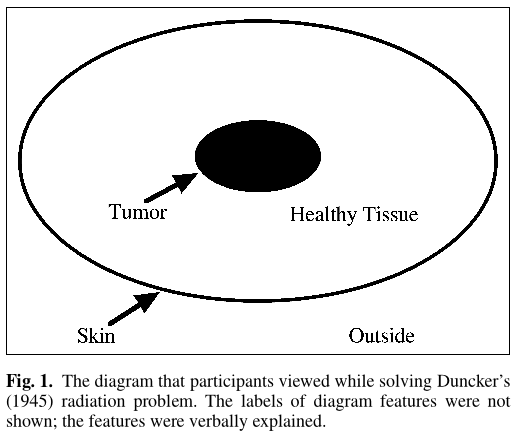
The main argument of this paper is that attention is not an outcome of cognition but it can help restructure cognition. The paper reports a study of participants solving a radiation problem. The movements of eyes was recorded over the associated image. The authors showed that participants who succesfully completed the task were more likely to look at the external part of the image. Then in a second experiment, the authors changed the graphical salience of this element, thus affecting the completition outcomes. They propose that eye movements patterns correlated with the problem solving process.
Overt visual attention during diagram-based problem solving, as measured by eye movements, has been used in numerous studies to reveal critical aspects of the problem-solving process that traditional measures like solution time and accuracy cannot address. In Experiment 1, we used this methodology to show that particular fixation patterns correlate with success in solving the tumor-and-lasers radiation problem. Given this correlation between attention to a particular diagram feature and problem-solving insight, we investigated participants’ cognitive sensitivity to perceptual changes in that diagram feature. In Experiment 2, we found that perceptually highlighting the critical diagram component, identified in Experiment 1, significantly increased the frequency of correct solutions. Taking a situated perspective on cognition, we suggest that environmentally controlled perceptual properties can guide attention and eye movements in ways that assist in developing problem-solving insights that dramatically improve reasoning.
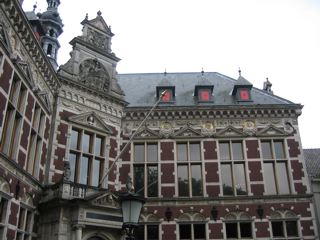
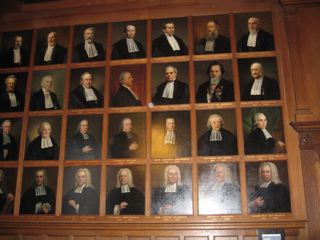
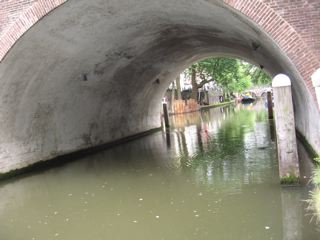
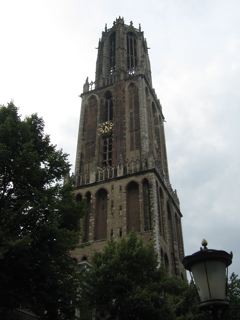
Utrecht is a great city! It has the atmosphere of Amsterdam with some more charm. The canals are a bit wider with some sidewalks on each side. I loved the place.



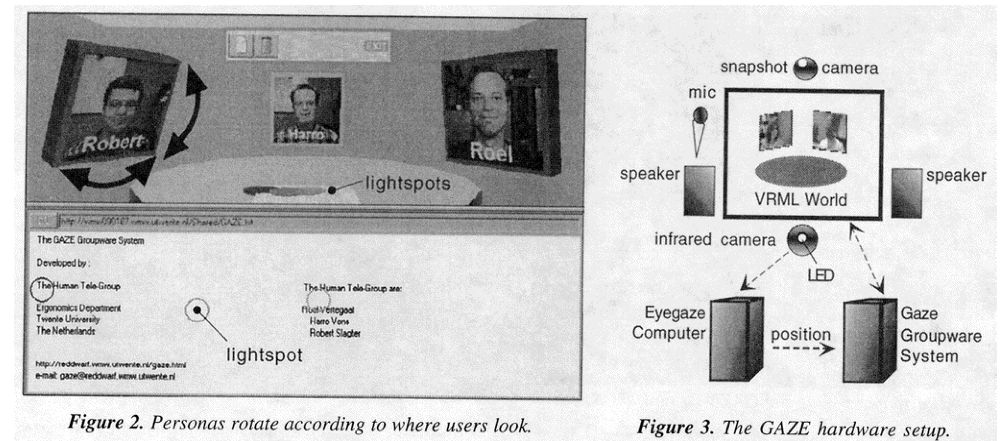
Vertegaal, R. (1999). The gaze groupware system: mediating joint attention in multiparty communication and collaboration. In CHI ’99: Proceedings of the SIGCHI conference on Human factors in computing systems, pages 294–301, New York, NY, USA. ACM Press. [url]
———
This paper argues that designing mediated systems is a problem of conveying the least redundant cues first. The central issue of supporting collaborative work at distance is that regardless of whether audio or video is used one should provide simple and effective means of capturing and methaphorically representing the attention participants have for one another and their work.
The authors quore Short et al.’s Social Presence Theory (1976), according to which communication media are ranked according to the degree to which participants feel co-located, and does suggest that the amount of social presence is improved by increasing the number of cues conveyed. However, when cues are redundantly coded, we can no longer predict the effects of a communication system. The authors concludes that we should avoid trying to improve communication by means of increasing bandwidth.
The authors concentrate on the problems of mediating multiparty communication, showing examples of how multiparty communication using video conferencing is not necessarily easier to manage than using telephony. Single-camera video systems do not comvey deictic visual references to objects or persons.
To overcome most of the limitations of previous approaches, the authors implemented a virtual meeting room where each the camera feed of each participant is represented in a moving panel that replicates the movements of the head of the real participant. This plus a lightspot on the shared workspace gives a sense of gazing at other participants and gazing at the objects used during the interaction.
The system is here described in great details but was no evaluation was reported. The paper conains also a graat review of studies showing the effect of conveying gaze direction in collaborative work.
 Tags: Computer Supported Collaborative Work, eye-tracking, human communication, human computer interaction
Schroeder, R., Heather, N., and Lee, R. M. (1998). The sacred and the virtual: Religion in multi-user virtual reality. Journal of Computer Mediated Communication, 4(2). [url]
——-
This paper presents participatory observations of virtual religious meetings. The authors participated for a coupe of weeks in these meetings and reported their experience comparing the virtual meetings to the actual meetings.
One of the difference the authors noticed was that virtual church permits design and experimentation of virtual spaces that are less constrained than a church in the real world. The authors pose the question on whether virual religion will have a corrosive or an invigorating effect on religion on the contemporary society. As Durkheim noticed, religious rituals consists of three elements: the physical co-presence of people to enhance emotionl energy, the ritualization of actions which includes a coordination of gestures and voices, and symbolic sacred object that reifies and reinforces the group’s sense of itself (1992, p.42). This three elements are absent in virtual encounters.
An interesting idea reported was that of sharing the prayers composed during the meetings with the rest of the community: “…Leader2 asks whether prayer requests may be passed to the world controller for display on a public space within the E-church world. This space, to which all will have access, fulfils the role of a church noticeboard or prayer letter, or the wider informal sharing of requests and needs which would naturally ripple out following the group meeting…”
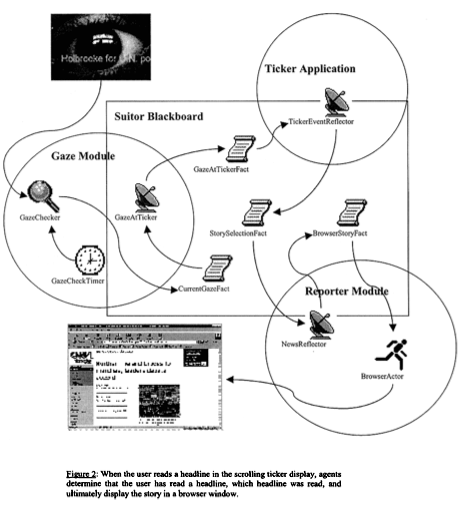
Maglio, P. P., Barrett, R., Campbell, C. S., and Selker, T. (2000). Suitor: an attentive information system. In IUI ’00: Proceedings of the 5th international conference on Intelligent user interfaces, pages 169–176, New York, NY, USA. ACM Press. [pdf]
———
This paper describes Simple User Interests Tracker, an attentive system that pays attention to what the user is looking at and through probabilistic models infers what his/her intrests might be. Then this information is used to create a peripherial awareness around the interesting topic.
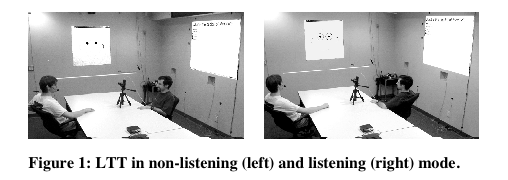
Oh, A., Fox, H., Kleek, M. V., Adler, A., Gajos, K., Morency, L.-P., and Darrell, T. (2002). Evaluating look-to-talk: a gaze-aware interface in a collaborative environment. In CHI ’02: CHI ’02 extended abstracts on Human factors in computing systems, pages 650–651, New York, NY, USA. ACM Press. [pdf]
———-
This short paper describes an experiments where participant pairs had to answer trivia questions. To get to the next question the participants had to interact with a software agent displayed on the wall. In different experimental conditions they could interact with the agent using: voice, gaze or text input. The experiments showed that look-to-talk was a better choice for natural human-computer interaction.
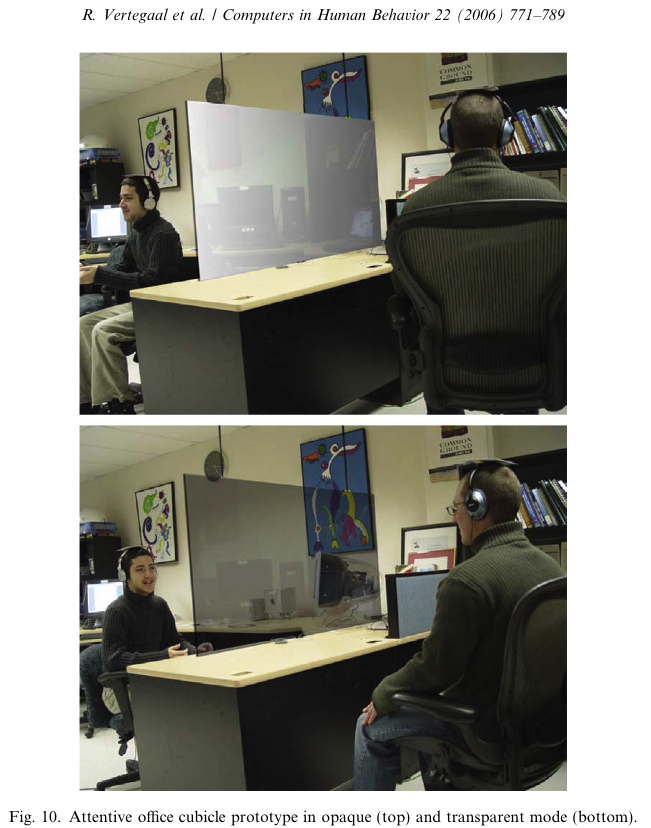
Vertegaal, R., Shell, J. S., Chen, D., and Mamuji, A. (2006). Designing for augmented attention: Towards a framework for attentive user interfaces. Computers in Human Behavior, (22):771–789. [pdf]
———
This paper contains a great review of attentive user interfaces. The authors’ argument is that computers are ill equipped to negotiate their communications with humans. The point is to design computers with channels to explicitly negotiate the volume and timing of communications with the user. The authors’ approach is to replicate human turn-taking strategies. In particular one features of face-to-face conversations indicates with great accuracy to whim the speaker wants to yield the floor: eye-contact.
Eye focus can be used to communicate the target of the user actions in a collaborative situation. The paper present a great review of systems or projects that aims at communicating user’s visual attention and interest in mediated group conversations or collaboration, like GAZE (Vertegaal et al., 1997) or SUITOR (Maglio et al., 2000).