Context-aware computing applications

B. Schilit, N. Adams, and R. Want, “Context-aware computing applications,” in WMCSA ’94: Proceedings of the 1994 First Workshop on Mobile Computing Systems and Applications, (Washington, DC, USA), pp. 85–90, IEEE Computer Society, 1994. [PDF]

——

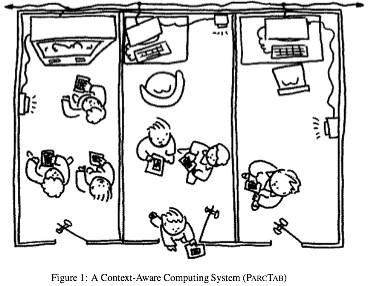
This paper describes software that reacts to an individual’s changing context. According to the authors, three important aspects of context are: where you are, who you are with, and what resources are nearby. Context includes different aspects of the physical environment around the user.

To investigate these topics they developed ParcTab, a small hand-held devices that uses infrared based cellular network for communication. The Tab acts as a graphics terminal and most of applications run on remote hosts.

Using this experimental environment, they describe four interaction mechanism:

  1. Proximate Selection, the located-objects that are nearby are emphasized or otherwise made easier to choose.
  2. Automatic Contextual Reconfiguration is the process of adding new components, removing existing components or altering the connections between components.
  3. Contextual Information and Commands happens when contextual information can produce different results accodring to the context in which they are issued.
  4. Context-Triggered Actions are sets of rules that specify how contex-aware systems should adapt.

ParcTAB.jpg

An operational definition of context

A. Zimmermann, A. Lorenz, and R. Oppermann, “An operational definition of context,” in CONTEXT’07: Proceedings of the 6th international and interdisciplinary conference on Modeling and using context, (Berlin, Heidelberg), pp. 558–571, Springer-Verlag, 2007. [PDF]

——–

This paper presents a summary of theoretical definitions of context that were developed in the past in the field of computer science. The authors’ argument presented in the paper is that most of the definitions that were proposed in the past were indirect definitions that used synonyms or that were either too general or incomplete.

By summarizing previous work, the authors presented an operational definition of context that could be used to characterize the situation of anentity. According to the authors, elements for the description of this context information fall into five categories:

  1. individuality
  2. activity
  3. location
  4. time
  5. relations

Also, according to the authors something is context because of the way it is used in interpretation, not due to its inherent properties. When interacting and communicating in everyday life, the perception of situations, as well as the interpretation of the context is a major part. Therefore, the author presents some operational additive to the general definition: context transitions, variation of approximation, change of focus, shift of attention, shared contexts, the establishment of relations, the adjustment of shared contexts, and the exploiting of relationships.

Zimmerman_context-petal-model.png

Toward a multidisciplinary model of context to support context-aware computing

N. A. Bradley and M. D. Dunlop, “Toward a multidisciplinary model of context to support context-aware computing,” Hum.-Comput. Interact., vol. 20, no. 4, pp. 403–446, 2005. [PDF]

—–

This paper presents a comprehensive literature review of multidisciplinary research on context. The primary aim of the authors was that of reviewing and merging theories of context within linguistic, computer science, and psychology to propose a multidisciplinary model of context that would facilitare application developers.

The authors find out that contextual interactions appered to comprise the cross-disciplinary component for understanding and using principles of context. From a liguistic perspective it is the interaction between two people, within computer science it is the user-application interaction (combined with possible interactions with other people and objects=, and within psychology it is the internal and external interactions. Last, contextual interactions should be considered also though the notion of embodiment, as described by Dourish (2001).

human needs

Thus man is a perpetually wanting animal. Ordinarily the satisfaction of these wants is not altogether mutually exclusive, but only tends to be. The average member of our society is most often partially satisfied and partially unsatisfied in all of his wants.

A. H. Maslow, A Theory of Human Needs, 1943

A Theory of Human Motivation

Maslow, A. H. A Theory of Human Motivation. Psychological Review, 50, 370-396. 1943. [HTML]

——-

This is a seminal paper by which Maslow first introduced the hierarchy of human needs. While reading the paper I highlighted a couple of interesting ideas:

– Any motivated behavior must be understood to be a channel through which many basic needs maby be expressed or satisfied.

– Classification of motivations myst ve based upon goals rather than upon istigating;

– Motivations are only one class of determinants of behavior. While behavior is almost always motivated, it is amolst always biologically, culturally and situationally determined as well.

– the present theory should be considered as a program for future research;

– a cause for reversal of the hierarchy is that when a need has been satisfied for a long time this need might become underevaluated.

– another partial eplanation of apparent reversals is seen in the fact that there are many determinant in behavior other than the need and desires (e.g. marthyrs).

– most members ofour society who are normal are partially satisfied in all their basic need and partially unsatisfied in all their basic needs ate the same time.

– our needs emerge only when more prepotent needs have been gratified. When a need is faily well satisfied the next prepotent (‘higher’) need emerge, in turn to dominate the conscious life and to serve as the center of organization of behavior, since gratified needs are not active motivators.

[a more extensive review here]

User needs for location-aware mobile services

Kaasinen, E. User needs for location-aware mobile services. Personal Ubiquitous Comput. volume 7, number 1, pp. 70-79. 2003. [PDF]

——–

This paper present a qualitative study of mobile services that could be enhanced with location-aware features thus providing the user’s point of view. The authors conducted interviews with 13 evaluation groups with a total of 55 persons of different ages, genders, ans socio-economic status. To guide the interactions, they provided participants with structured scenarios and prototypes that they had to test. Also, they conducted interviews with experts during a conference.

The paper draws conclusion about key issues related to users’ needs. Topical information, the kind of information that might change while the user is on the mobe, turned out to be important to the user (e.g., weather forecast, train schedule). They also identified the push vs pull modality of delivery information to the user as being one of the possible issued with designing these kind of services. Users declared the need of having detailed search options, the ability of personalizing the interaction with the service and that of contributing to the system providing data. Also, they discussed the need of giving the ability to the user to override the recommendations of the system (e.g., exporatory search). Privacy was also mentioned.

Understanding and Using Context

Dey, A. Understanding and Using Context. Personal and Ubiquitous Computing, Vol. 5, No. 1. (20 February 2001), pp. 4-7. [PDF]

——–

This work builds on previous studies of contextual applications and proposes to define what context is a what context-aware applications are. The author refer to the work of Schilit and Theimer (1994) where context is referred to as location, identities of nearby people and objects, and changes to those objects. A later definition of Schilit , Adams, and Want (1994) and the definition of Pascoe (1998) defines the important aspects of context, which are: where you are, who you are with, and what resources are nearby.

The author consider these definitions as too generic and presents his own: “Context is any information that can be used to characterise the situation of an entity, place, or object that is considered relevant to the interaction between a user and an application, including the user and applications themselves.“

Subsequently, the author defines context-aware applications as: “A system is context-aware if it uses context to provide relevant information and/or services to the user, where relevancy depends on the user’s task.” According to the author, there are three categories of features that a context aware application can support: a) presentation of information and services to a user; b) automatic execution of a service for a user; c) tagging of context to information to support later retrieval.

As a last contribution, the paper introduces the situation abstraction, which is an aggregated description of the states of relevant entities.

Understanding mobile contexts

S. Tamminen, A. Oulasvirta, K. Toiskallio, and A. Kankainen, “Understanding mobile contexts,” Personal Ubiquitous Comput., no. 8, pp. 135–143, 2004. [PDF]

——–

This paper describes an ethmomethodologically inspired study of 25 participants in Helsinki. The authors were interested in understanding the challenges that ubiquitous computing has to face because of the changing context of the user. The authors wrote their implications thinking about phisical devices mor than thinking about services.

Starting from the definition of context in the HCI field, the authors describe how scholars did not agree on a single definition of context. Their starting point was that contexts are always determined by their specific use situations in relation with the motives, plans, other poeple, mobile computers, and the like. They believe that by explicating the actions and resources by which people go about, they can gain insight on how mobile contexts get done and the extent by which these can be modeled and recognized by ubiquitous devices. The authors organized a group of 25 participants that they shadowed and interviewed during the course of 3 days.

Their storyline was divided into travel episodes consisting of temporally organized action patterns depicting a meaningul journey between two places. A special emphasis was given to finding nodal events, where an action transformed the present context into another recognizable context (e.g., reading the newspaper on the metro).

They describe 5 characteristics of mobile contexts: 1) situational acts within planned ones, actions performed in ad-hoc manner during the journey. Plans do not simply determine action (Suchman). 2) claiming personal an group spaces, users create space around themselves for the actions they are about to take. 3) social solutions to problem sin navigation, seeking help through the social channel. 4) temporal tensions, situations where time becomes problematic in relation to the action at hand and where, at the same time, the temporal aspect of a situation is actively used to orient action. 5) multitasking, social conventions might reduce some cognitive load.

vanilla version of a software

In information technology, vanilla (pronounced vah-NIHL-uh ) is an adjective meaning plain or basic. The unfeatured version of a product is sometimes referred to as the vanilla version. The term is based on the fact that vanilla is the most popular or at least the most commonly served flavor of ice cream.