… technology tends to overwhelm common sense
[D.A. Freedman]
If this is a Man
I found some minutes for my blogroll and I red this post of Beppe Grillo on a crime story (the article is in Italian only) in southern Italy. It is just one of those stories that appears more and more frequently in the news. We tend to underestimate its value because of this bias of repetition, but in fact, it is an horrible example of how our society is becoming more and more corrupt.
Crime is bad, but there are different kinds of crimes. Violence is bad, but there are different kinds of violence. Given a certain series of circumstances we should try to understand people who committed violent crimes. However, when it comes to violence on minors, then I am not able to feel any forgiveness in my heart. It is the one-case where I doubt about the death penalty, and worse …
Two portraits fits very well in our evolving-society: the first one that came to my mind was Primo Levi‘s book “If this is a Man“; the second is Marco Risi’s movie “il Branco“.
I feel sad, and scared: where are we going?
The world of real estate finance: urban pedagogy
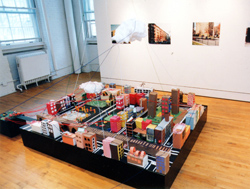
Where does the money to build and repair buildings come from? How is it controlled? What fights happen about it? In preparation for an exhibition and DVD commissioned by CAVS, Rich has spent the semester learning about mortgage markets, banking regulation, and financial literacy in an attempt to answer these questions. In this presentation, he’ll do his best to make sense of it.
CUP is a nonprofit organization that does creative education about places and how they change. CUP brings artists and designers together with community-based advocates and researchers to create public education projects ranging from high school curricula and public installations to websites and TV shows.
Recent projects include: an exhibition on the urbanism of Knoxville, Tennessee; historical signage for a Brooklyn hip-hop clothing mecca; and redesigning public school classrooms as nomadic environments. Learn more at www.anothercupdevelopment.org.
CUP works with youth to create collaborative projects that explore the urban environment. Our educational projects build on the everyday experiences of young people to ask questions about democracy, civic participation and social justice. We believe that civic engagement requires a new kind of civic education, one that explains how important decisions actually get made, what is at stake, and how residents can be involved. Our projects use art, design, and technology to draw the connections between everyday life and the decisions that give it form.
 Tags: education, eGov, environment, pedagogy, urban, urban exploration, urban planning
Mental map of London
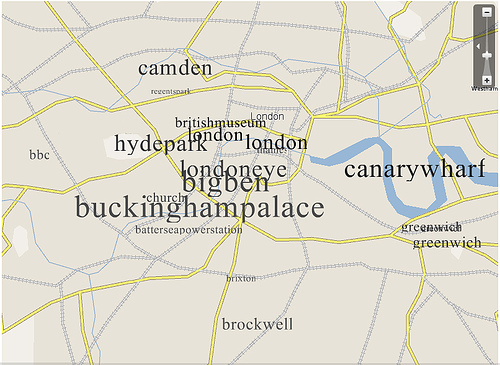
Fab pointed me to this interesting post of the Yahoo! Research Berkeley blog. The author played a bit with the most frequent tags that are used to annotate the Flickr pictures taken in London. The tag cloud elaborated with these is then mashed-up with the map of London with the aim of building an analogue of Stanley Migram’s Psychological Map of Paris.
In 1976, social psychologist Stanley Milgram asked his subjects to list places of interest in Paris. Milgram then aggregated the results, effectively creating an “attraction map” of Paris with landmark names appearing in a larger font according to the number of subjects who mentioned each.
…
By taking a photo, photographers essentially express their interest in a particular place. Individual pictures taken at a specific location act as “votes” in favor of that location’s interest, much like the explicit input of Milgram’s subjects. Further, additional information can be extracted from the tags attached to these photos on Flickr. Tags that frequently appear in images from a specific location but are otherwise rare suggest a topic unique to the location.
I found this approach extremely interesting. We can learn so many things from these social platforms like Flickr or del.icio.us, etc. We are just exploring the tip of the iceberg. For instance, I remember another post by Fabien on heatmaps on Google Maps. In the example the authors provided an heatmap of the traffic congestion. The same technique can be used for instance to see which tiles are downloaded more frequently from GMaps or Microsoft Live. These information can have a tremendous value for Urban Planners, but I still have to find a good example of how such information has been set into practice and solution.
The point is that in most of the cases, companies like Google or Microsoft or Yahoo do not allow outsiders to play with their database even for research purposes. Crossing the data from two different services belonging to two different companies is just not possible.
Copyright notice: the present content was taken from the following URL, the copyrights are reserved by the respective author/s.
Tags: data mining, folksonomy, geography, google, map algorithms, maps, psychogeography, research, search engine, tagging, urban, urban exploration, urban planning
Who is paying my bandwidth?  :
Enjoy a nice substitute to a hotel and stay in new time shares! Enjoy the sites with your family in amazing time shares for rent . Check out some popular areas and their time share guidelines. Whether you are looking to stay the summer or just a week, time shares for sale are what you are looking for. Read up on how time shares operate before you make your purchase!
ShoutSpace experiment
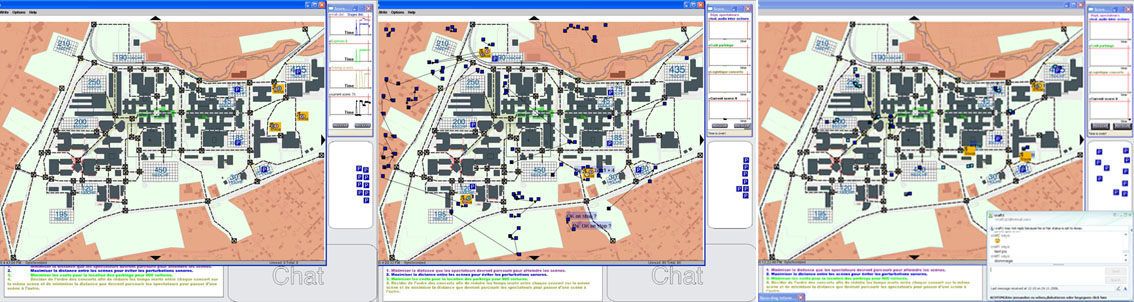
Some initial screenshots from the experiment I am conducting with ShoutSpace. We decided to have three experimental conditions: the first where participants can communicate using a standard chat utility. The second where participants enrich the conversation with spatial information and finally a mixed condition where they are free to use a standard utility or the spatialized one.
Running pre-experiments is extremely important to understand how to correctly balance the experiment and how to prepare the descriptions of the setting. A little difference in these documents might result in a complete different result. The next step is to understand how to analyze the tons of data that we are collecting.
Marcher à mon aise
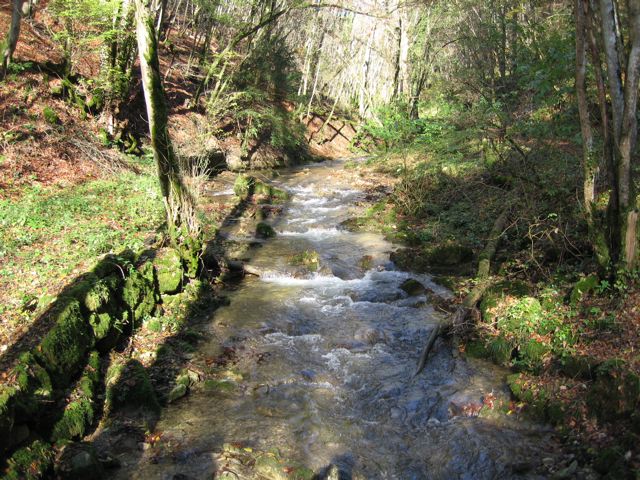
J’aime à marcher a mon aise, et m’arrêter quand il me plaît. La vie ambulante est celle qu’il me faut. Faire route à pied par un beau temps, dans un beau pays, sans être pressé, et avoir pour terme de ma course un objet agréable: voilà de toutes les manières de vivre celle qui est la plus de mon goût.
Jean-Jacques Rousseau, “Les confessions”
(livre quatrième)
Google search for code
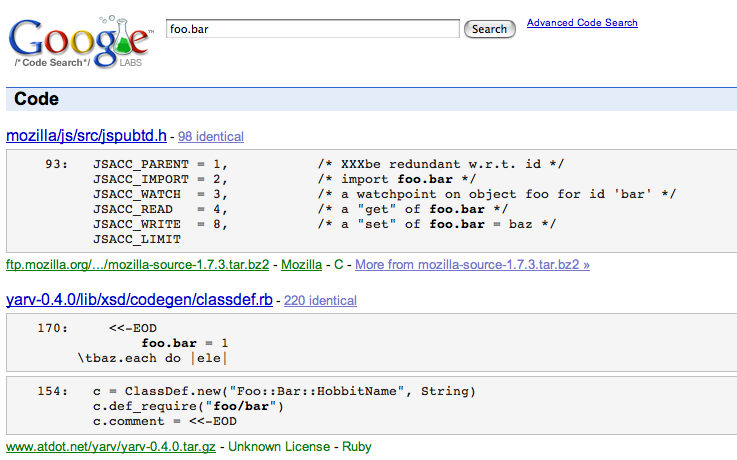
Google recently released a special search portal for code. There are some features of code which are extremely difficut to capture for conventional search engine. Also the display of the results seems to play a great deal on the usefulness of such systems. This last product from google seems to be pretty clean and easy to use. I still have to test it intensively though.
Tags: google, search engine
SimCity for real
Social policy makers and town planners will soon be able to play ‘SimCity’ for real using grid computing and e-Science techniques to test the consequences of their policies on a real, but anonymous, model of the UK population. Dr Mark Birkin and colleagues, who are developing the model at the University of Leeds, will be demonstrating its potential at the UK e-Science stand at SC06, the world’s largest supercomputing conference in Florida, this week.
[more]
Tags: education, eGov, politics, simulation, urban, urban exploration, urban planning
Bliin: a social networking service
Nothing new here, but still nice to see that people are interested in multemedia content attached on a map:
bliin YourLIVE! is a social networking service where users can spot, trace and share experiences — pictures, videos, audio and text — with one another in real-time on a Google Map.
Users create ‘bliins’ to navigate and monitor their interests in a location or area. bliins can be saved and shared amongst users. bliin is powered by GeoTracing and built on KeyWorx.

Tags: map algorithms, maps, urban exploration
An improvement of the feedback tool
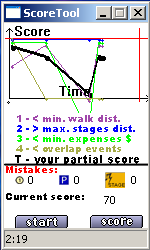
This week I finalized the feedback tool that I am going to use for the controlled experiment for my thesis. I started with a basic set of features and I wanted to keep the tool minimal. However, for a certain design principle, which I still have not named, things tend to get complex as soon as they need to be used by generic users … 🙂
Anyway, it was fun to learn how to properly build client/server applications with Python, and learning how to use the message Queue. Once more, I am confirmed that Python is fun!
The thumbnail below shows the latest version of the feedback tool. I worked on the readability of the graph and I added some detailed information on what could have been causing a low-score. Finally I added some logging features. Still, I am not super-satisfied with the result but time is running short.